
Embroidery & Design: A Quiet Dialogue Across Eras
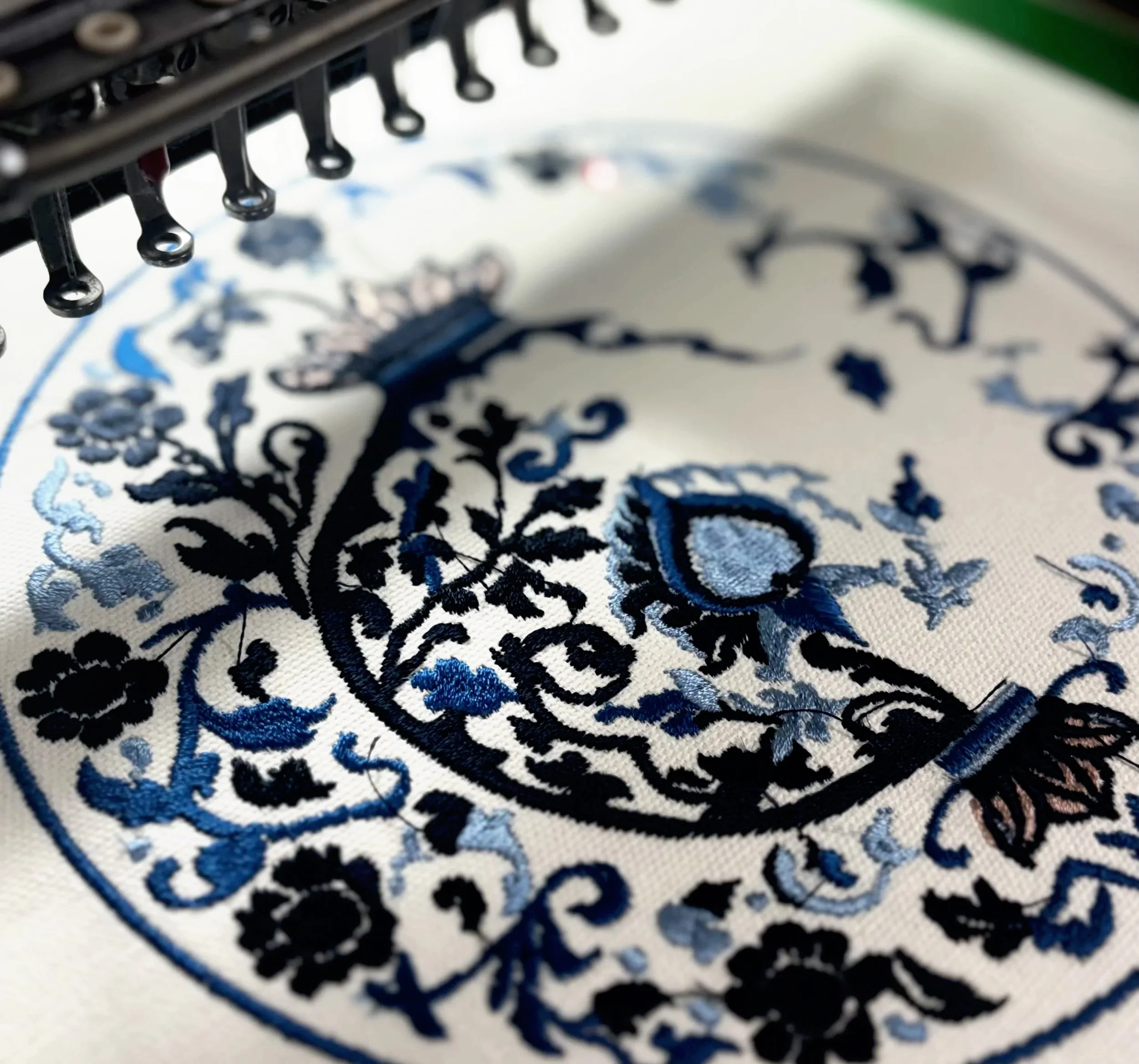
Blu Pietra embroidered on 100% cotton
There is a moment, when you look closely at a well-made piece of embroidery, where the logic of it becomes visible. Not just the image, the way it was made. The direction of the stitches, the slight rise of thread against ground fabric, the way colour is built not by mixing but by layering, strand over strand, decision by decision. It is one of the few design forms where the process remains legible in the finished object. You can read it, almost like a hand.
I find that extraordinary.
Embroidery is also one of the most unforgiving mediums for a designer to work in. It does not accommodate ambiguity. Abstract washes of colour, photographic gradients, imagery that relies on blending or atmospheric softness, these simply do not survive the translation into thread. What embroidery rewards, instead, is the motif. The repeat. The symbol with enough structure to hold its meaning at close range and at distance, in a single stitch and across the whole composition.
This is why the history of embroidery is inseparable from the history of pattern; from the botanical manuscripts of Mughal courts, the geometric tilework of Iznik, the dense floral grids of European crewelwork. These traditions did not produce such rich embroidered textile languages by accident. The motif was the unit of embroidery precisely because it was the thing embroidery could carry best.
It was this quality, the way the form demands a certain kind of design thinking, that drew me to it.
My design language is rooted in the motif: in architectural ornament, in tilework, in the botanical and geometric patterns that recur across cultures and centuries. When I began developing the Jardin Nar collection, drawing from the tulip gardens and pomegranate imagery of Türkiye, the decision to embroider felt less like a choice than a recognition. The composition, the way the forms radiate outward, the rhythm of the leaves, the weight of the central pomegranate, was considered as much for how it would feel stitched as for how it would read as a design.
The Baadiyah collection, drawn from the ancient landscapes of the Aravallis in India, asked something different of the medium. Here the motifs are quieter, more contemplative, each repeated tree form complete in itself. There is something in the repetition of embroidery that suits certain subjects particularly well. The act of stitching the same form again and again carries its own meditative quality, and the finished object seems to hold that quality within it.
Bringing these designs into thread is the work of my sibling Arpita at Slow Earth Studio in Mumbai, who partners with us on every embroidered piece. She works closely with skilled local artisans, people who carry decades of generational knowledge. They understand how thread tension alters surface quality; how the same motif, stitched more loosely, sits differently in the cloth; how to build warmth and depth out of cotton thread on a natural ground. These are not things that can be fully specified in a brief. They are felt, adjusted, refined in the making.
Every piece that leaves us carries that knowledge within it. When you feel the raised detail of a Jardin Nar cushion cover, or run a thumb along the Baadiyah motifs on an atelier tote, you are feeling the result of hundreds of small decisions.
The embroidery is not decoration applied to an object. It is the record of a process. A quiet archive of care.
— Alpesh, Founder, Bombay Design Co. I'd love to hear from you, write to me at alpesh@bombaydesign.co