
How to Mix Patterns in Small Spaces
Mixing patterns in a small space comes down to three working rules: vary the scale so patterns complement rather than compete, keep them inside a shared colour palette so the room reads as one story, and give the eye places to rest with solid colours and plain texture. Follow those three and a compact room can hold three or even four patterns comfortably. Ignore them and even two will quarrel.
I say this with some confidence because I design patterns for a living and live in a London flat. Nothing sharpens your views on pattern-mixing quite like a home with no room for mistakes. Every motif I sketch eventually has to survive my own small rooms, and the rules below are less theory than the scar tissue of getting it wrong first.
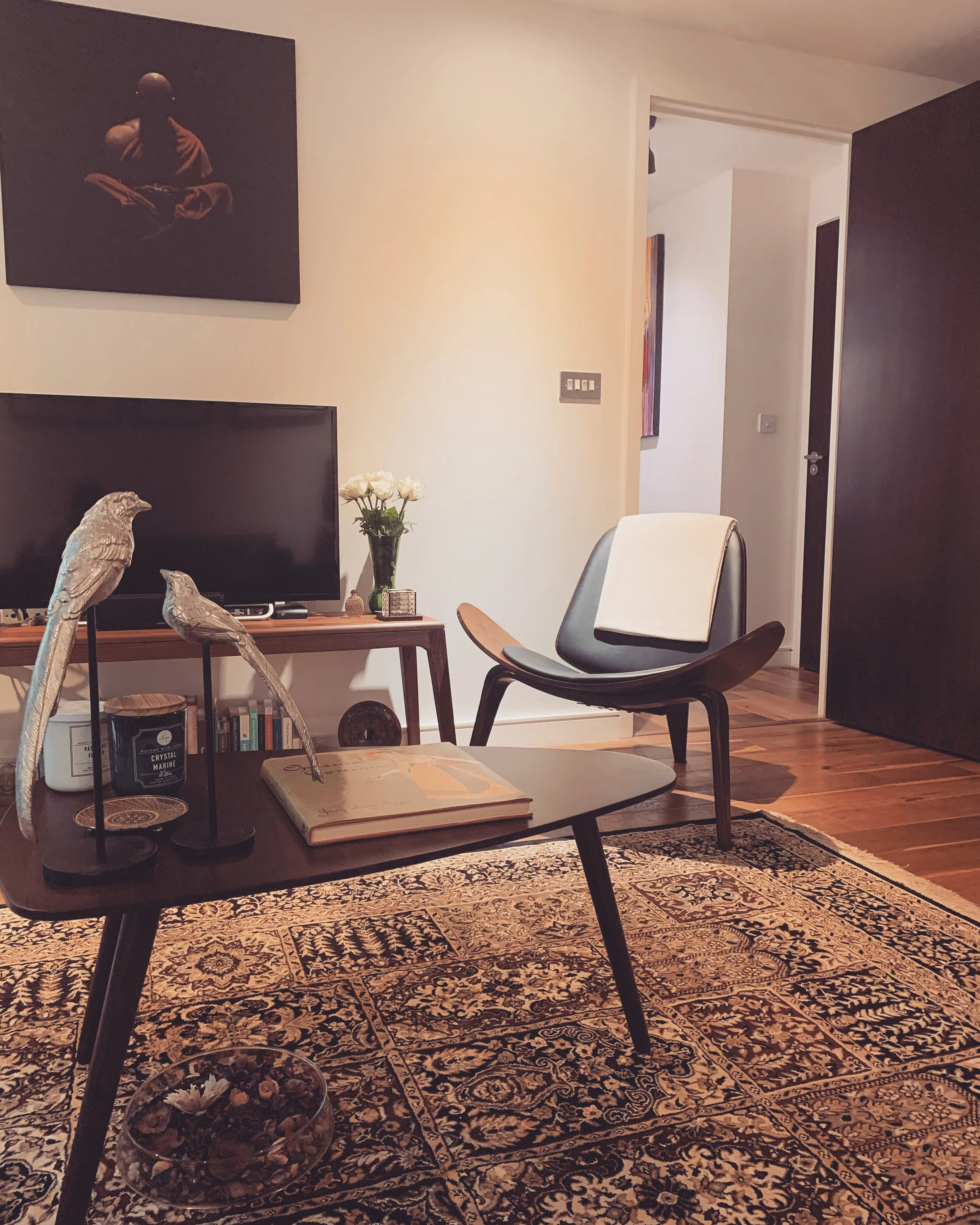
My own living room in London: one confident pattern doing the talking, and everything else holding its place quietly.
Rule one: vary the scale
The most common pattern-mixing mistake has nothing to do with colour. It is scale. Two patterns of the same size and density will fight, because the eye cannot decide which one to read first. The fix is a simple hierarchy: one large, dominant pattern, one medium pattern, and, if you like, one small, tight pattern that reads almost as texture from across the room.
In a small space, this hierarchy matters even more, because everything sits closer together. A bold, generous motif on a cushion, a medium floral on a throw, a fine stripe or weave underneath: three different scales, no argument.
Rule two: share a palette
Patterns from completely different traditions will happily live together if they share colours. This is the secret behind rooms that mix a Turkish-inspired floral with a geometric print and somehow look intentional rather than accidental: somewhere in each pattern, the same two or three tones repeat. When you pick your patterns, lay them side by side and ask what colours they have in common. If the answer is none, one of them belongs in another room.
A small space usually can't sustain more than one palette, so choose it deliberately: a grounding tone, a warm accent, and the neutral of your base fabrics. Let every pattern in the room touch at least one of those.
Rule three: let solids do the resting
Pattern needs silence around it the way music needs rests. In a large room, plain walls and floors provide that silence automatically; in a small room, you have to build it in. A patterned cushion earns its presence when it sits against a solid sofa. A printed napkin sings on a plain tablecloth. If every surface carries a motif, the room stops being layered and starts being loud, and small rooms amplify loudness faster than large ones.
A useful check: stand at the door and squint. If your eye can't find anywhere to land, remove one patterned thing. The room will thank you.
Count texture as a pattern
This is the rule most guides miss. Weave, embroidery, scallop edges, and slub in natural cotton all read as pattern at close range, and small spaces are all close range. A hand-embroidered motif carries more dimension than a printed one, the thread sits proud of the cloth, catches side-light, and adds a quiet third layer between "plain" and "patterned." This is why a simple pairing, one embroidered piece, one printed piece, one textured solid, can feel richer in a small room than five prints ever would. Texture gives you depth without adding noise.
Put pattern where the eye travels, not everywhere
In compact homes, place pattern at a few deliberate heights and let the zones between them stay calm: a cushion at seat level, a runner or spread at table level, perhaps one framed print at eye level. This vertical rhythm makes a room feel composed and, usefully, taller. Resist the instinct to fill every gap; in a small space, the gaps are doing structural work.
Textiles are the low-commitment way in
The great advantage of mixing patterns through textiles, cushions, table linens, napkins, a tote hung on a peg, is that nothing is permanent. Wallpaper commits you; a cushion cover is a conversation you can change your mind about. Start with two pieces that share a palette but differ in scale, live with them for a fortnight, then add or subtract. Small spaces reward this slowness, because every addition is proportionally larger there than it would be in a bigger room.
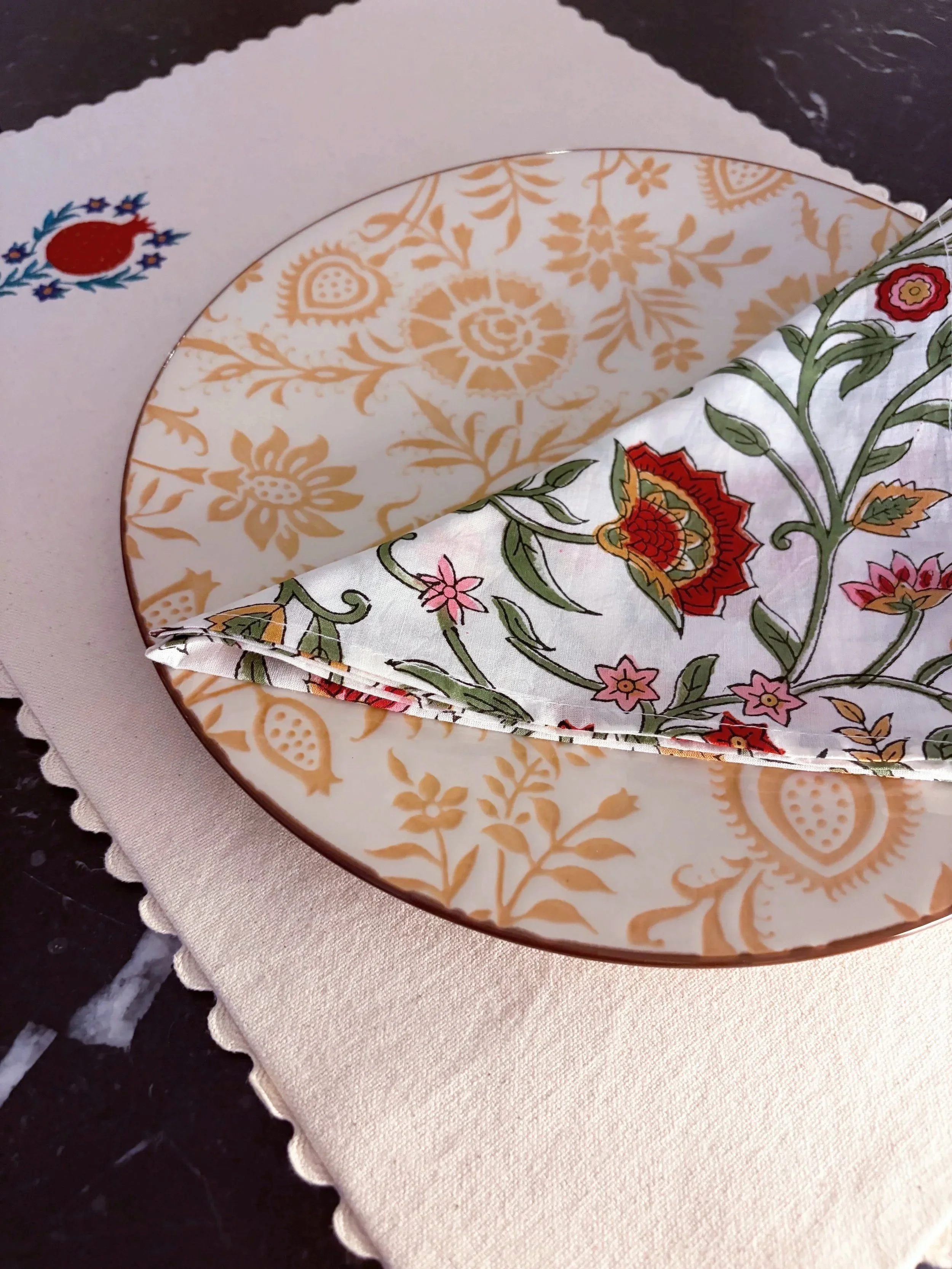
Jardin Nar embroidered cotton tablemat paired with floral screen-printed cotton napkin.
This is, as it happens, how we design at Bombay Design Co. Our collections are built to layer: the Jardin Nar table spread pairs a bold embroidered pomegranate motif with fine screen-printed floral napkins, two scales, one palette, texture against print, which is rules one, two, and four working in a single table setting. The same logic runs through the cushions: a generous embroidered motif on natural cotton, designed to sit against a solid sofa and let the plain weave around it do the resting. We design each piece to be the confident pattern or the quiet companion, so they mix without needing a stylist in the room.
A small room, mixed well, is not a compromise. It is a concentrated one, every pattern chosen because it earns its place, every plain surface working as hard as the printed ones. That, in the end, is all good pattern-mixing is: a few things speaking clearly, and enough quiet for you to hear them.
— Alpesh, Founder, Bombay Design Co. I'd love to hear from you, write to me at alpesh@bombaydesign.co