
The Architecture of Pattern: Iznik, Azulejos, and Jali
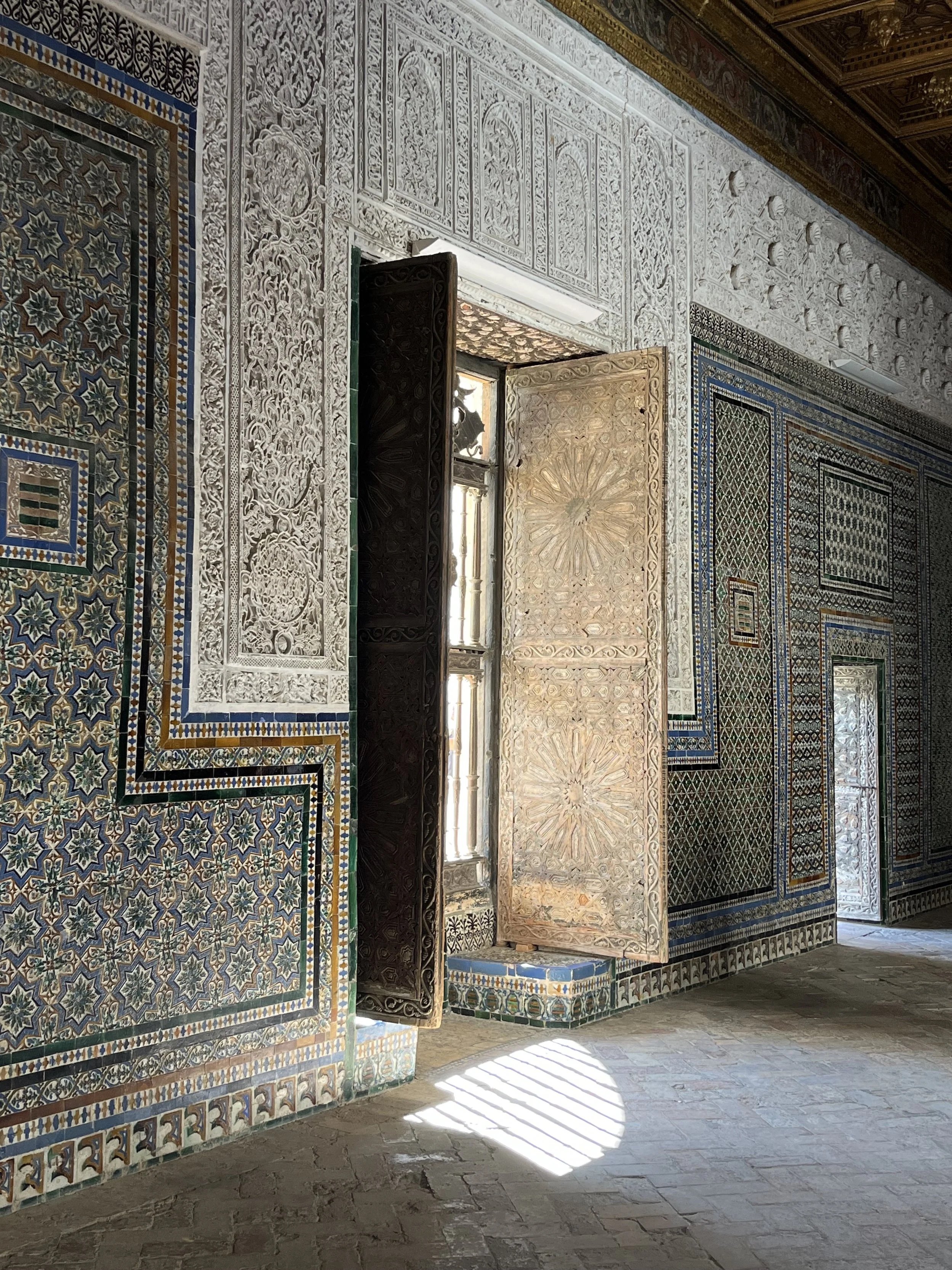
Azulejos in Seville, Spain.
Before there was writing, there was pattern. Before the sentence, the symbol. Before the archive, the mark repeated across stone and cloth and clay until it carried meaning simply by existing, by recurring, by being recognised.
The motif is one of humanity's oldest design instincts. And what strikes me, having spent years moving through cities and cultures that take pattern seriously, is not how different these design languages are from one another, it is how much they share. The same impulse, expressed through entirely different hands, arriving at forms that rhyme across continents and centuries.
In Istanbul, the tulip is everywhere. It climbs the walls of the Rüstem Pasha Mosque in Iznik tilework, cobalt blue, coral red, emerald green, painted by hand and fired to perfection in the 16th century. What appears at first glance as decoration is, on closer reading, a vocabulary. The tulip in Ottoman design carried specific symbolic weight: divine order, spiritual purity, the natural world held in perfect balance. The artists working in the imperial ateliers did not simply choose it because it was beautiful. They chose it because it meant something, and because that meaning could be read by anyone who knew the language.
In Seville, the walls speak differently but with the same intention. The azulejos of Andalucía trace their origins to the Moors of North Africa, who brought with them the Islamic tradition of geometric tilework, the interlocking star and polygon, the arabesque that scrolls and returns, the pattern that could theoretically extend forever in any direction. The name azulejo comes from the Arabic al-zellige, meaning polished stone. The geometry was never purely decorative; for the Moorish craftsman, it was a representation of mathematical and cosmic order, the divine expressed through precision and repeat. When the Reconquista brought those same walls under Christian rule, the tradition did not disappear, it was absorbed, adapted, layered with new imagery. The motif survived the change of hands because it was too deeply embedded in the stones to remove.
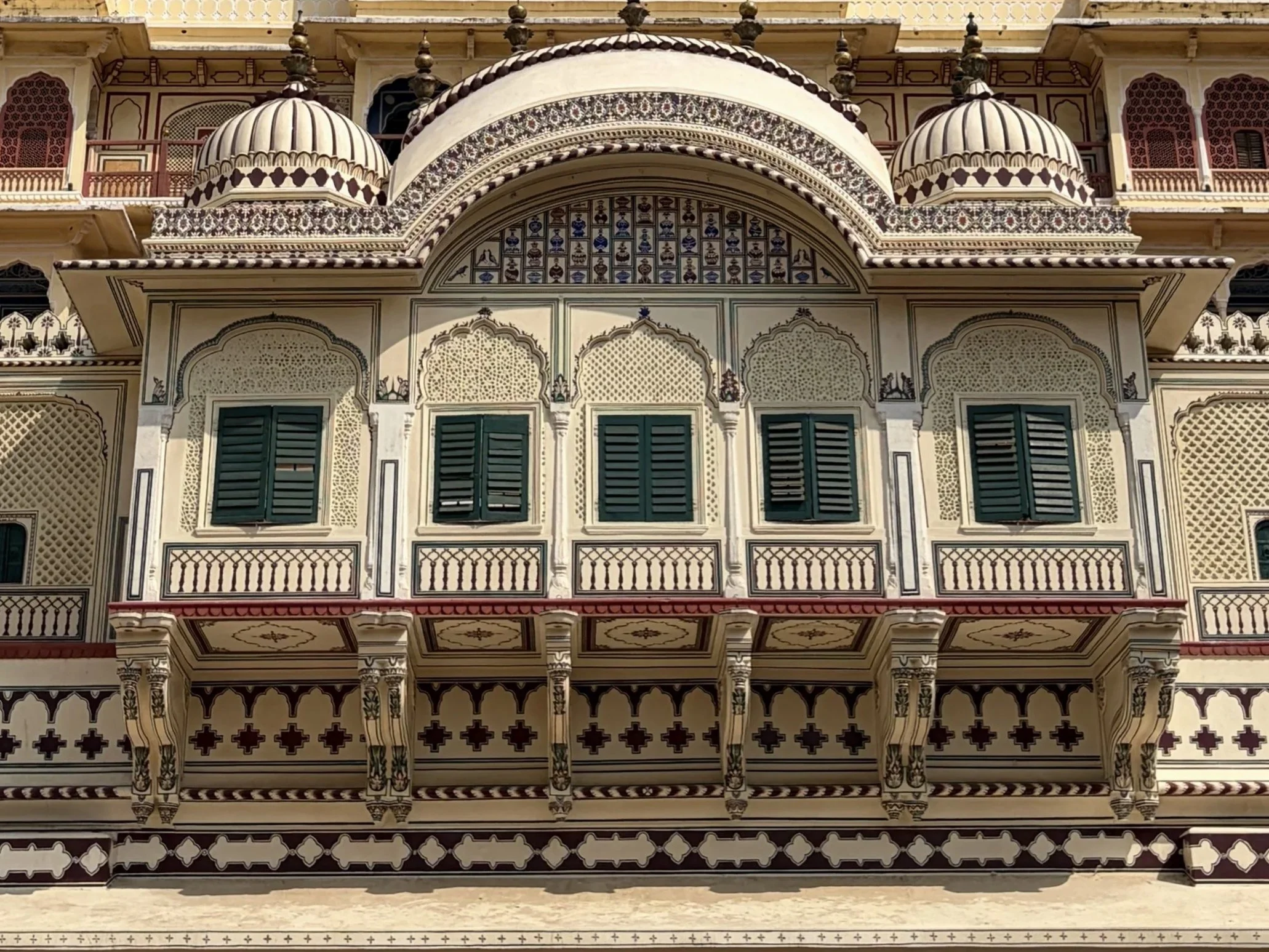
Intricate jali work can be seen on the walls of city palace in Jaipur, India
In Jaipur, the surface itself is the statement. The carved jali screens of Rajasthan, stone latticed into geometric flowers, stars, and interlocking grids, were designed not merely as ornament but as a way of mediating between inside and outside, light and shadow, the seen and the partially concealed. The motif here is architectural, structural, functional and symbolic simultaneously. To stand inside a room filtered through a jali screen is to understand that pattern can alter an experience of space entirely — that the repeat is not just something to look at but something to be inside.
And in Japan, the ancient architectural traditions of Ise and Nara hold a different kind of pattern lesson. Here the repeat is not across a surface but through time, the same carved forms, the same symbolic gestures, reproduced with extraordinary faithfulness across centuries of reconstruction and renewal. The motif in Japanese temple craft is understood as a custodial act. To reproduce it accurately is to honour what was passed down, to maintain the thread of continuity between the maker and all the makers who came before.
What all of these traditions understand, I think, is that the motif is a form of compressed knowledge. It carries history, meaning, and cultural memory within a single repeating form. It is legible across languages. It survives the passage of time in a way that text-based communication rarely does, because it is felt as much as read, because it speaks to something in us that recognises pattern before it recognises meaning.
This is why, at Bombay Design Co., the motif is always where we begin. The pomegranate at the heart of the Jardin Nar collection. The tree forms of Baadiyah, drawn from the Aravallis. The geometric medallions of Bombay Deco, held within their scalloped frames. Each of these forms carries a history that predates its appearance on our products by centuries. We did not invent them. We recognised them, the way you recognise a word in a language you are still learning. And we tried to bring them forward with the same care that every craftsman before us brought to the same task.
The motif endures because it was never just decoration. It was always a way of saying something that words could not quite hold.
— Alpesh, Founder, Bombay Design Co. I'd love to hear from you, write to me at alpesh@bombaydesign.co