
Natural Cotton: Designed for the Senses
There are materials that announce themselves. That catch the light deliberately, that ask to be noticed, that perform.
Cotton is not one of them.
Cotton does something quieter and, I think, more profound. It receives. It settles. It becomes more itself with time and use rather than less, softening at the edges, deepening in texture, growing warmer in the hand with every wash. It does not resist the world around it. It absorbs it.
I have been drawn to natural cotton for as long as I can remember, long before I had the language to explain why. Growing up in India, cotton was simply everywhere, in the heat-softened kurtas of the city, in the dhotis of men sitting on steps in the early morning, in the bolts of fabric piled high in the textile markets of Bombay. It was the fabric of daily life in the most literal sense: unremarkable, indispensable, quietly present.
It was only later, reading about Gandhi's khadi movement, that I began to understand what cotton could carry beyond its physical qualities. In 1920, Gandhi called on Indians to spin their own cloth, to return to the charkha, the hand spinning wheel, as an act of economic self-determination and cultural resistance. The idea was radical in its simplicity. By spinning and wearing khadi, homespun cotton, Indians could withdraw from dependence on British mill-made cloth and reclaim something that had always been theirs. Cotton became political. It became identity. It became, in Gandhi's hands, one of the most powerful symbols of a movement that would change the world.
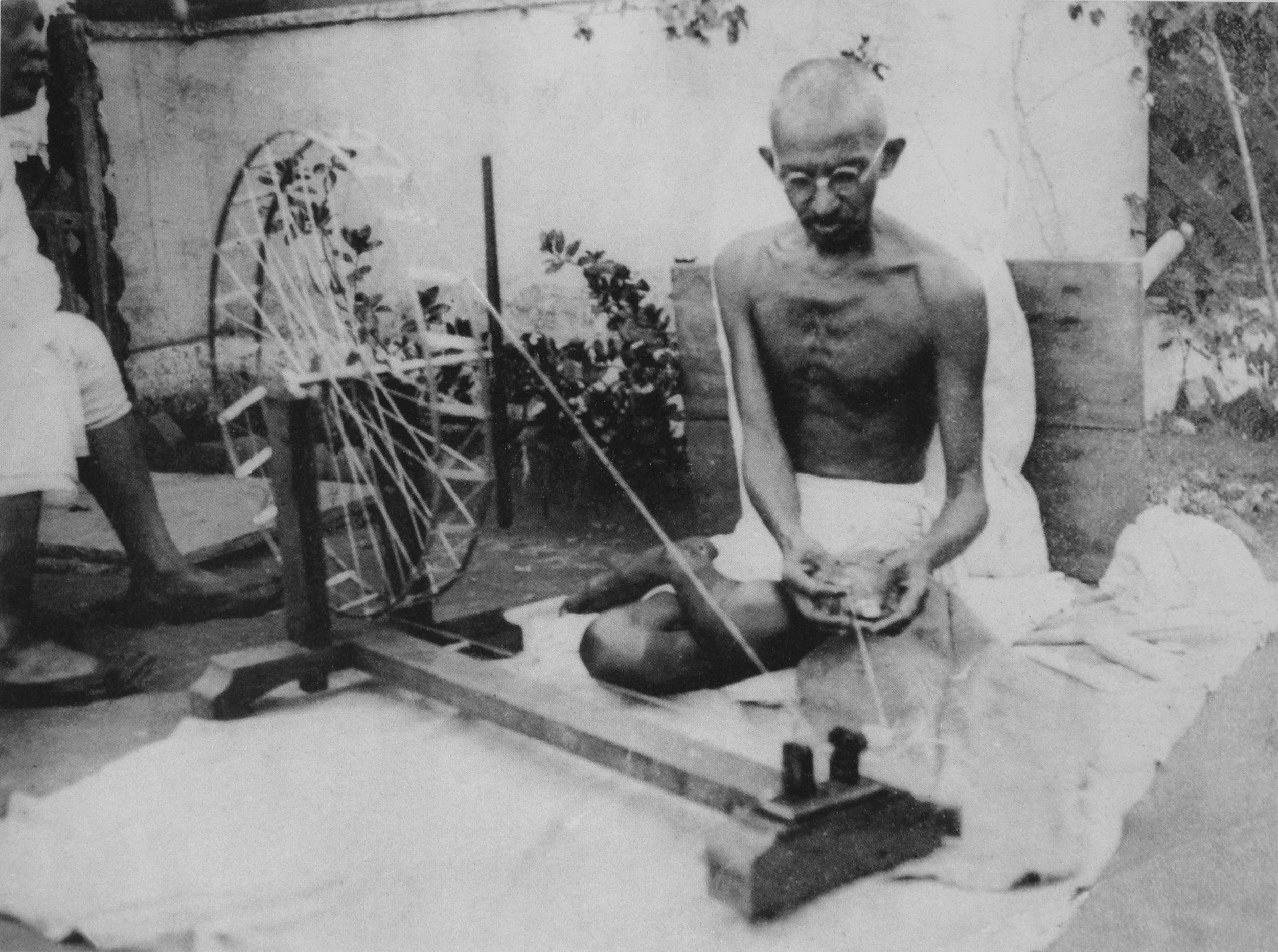
Gandhi at the charkha. Source: Wikimedia Commons
What strikes me about that story is not just its political force but its material logic. Gandhi did not choose cotton arbitrarily. He chose it because it was the fabric India already knew, had always known. India had been producing the finest cotton textiles in the world for millennia. The muslin of Dhaka was so extraordinarily fine that traders called it woven air. Cotton thread had passed through Indian hands for so long that the knowledge of it was embedded not just in technique but in instinct, in the body, in the culture. When Gandhi asked Indians to return to it, he was asking them to remember something they had never truly forgotten.
That depth of relationship between a people and a material is something I feel when I work with cotton today. Not in any grand or political sense, but in the quiet, sensory way that natural things communicate when you pay attention to them.
Natural cotton receives embroidery differently from a synthetic ground. The thread beds into it rather than sitting on top of it, the needle finds less resistance, and the finished stitch carries a warmth that synthetic fabric simply cannot replicate. Arpita from Slow Earth Studio talks about this when she describes working with artisans on our embroidered pieces: the way natural cotton moves with the thread rather than against it, the way the ground fabric and the embroidery become a single thing rather than two separate layers. When you run a hand across a finished piece on natural cotton, what you feel is not decoration on a surface. You feel the surface and the decoration as one.
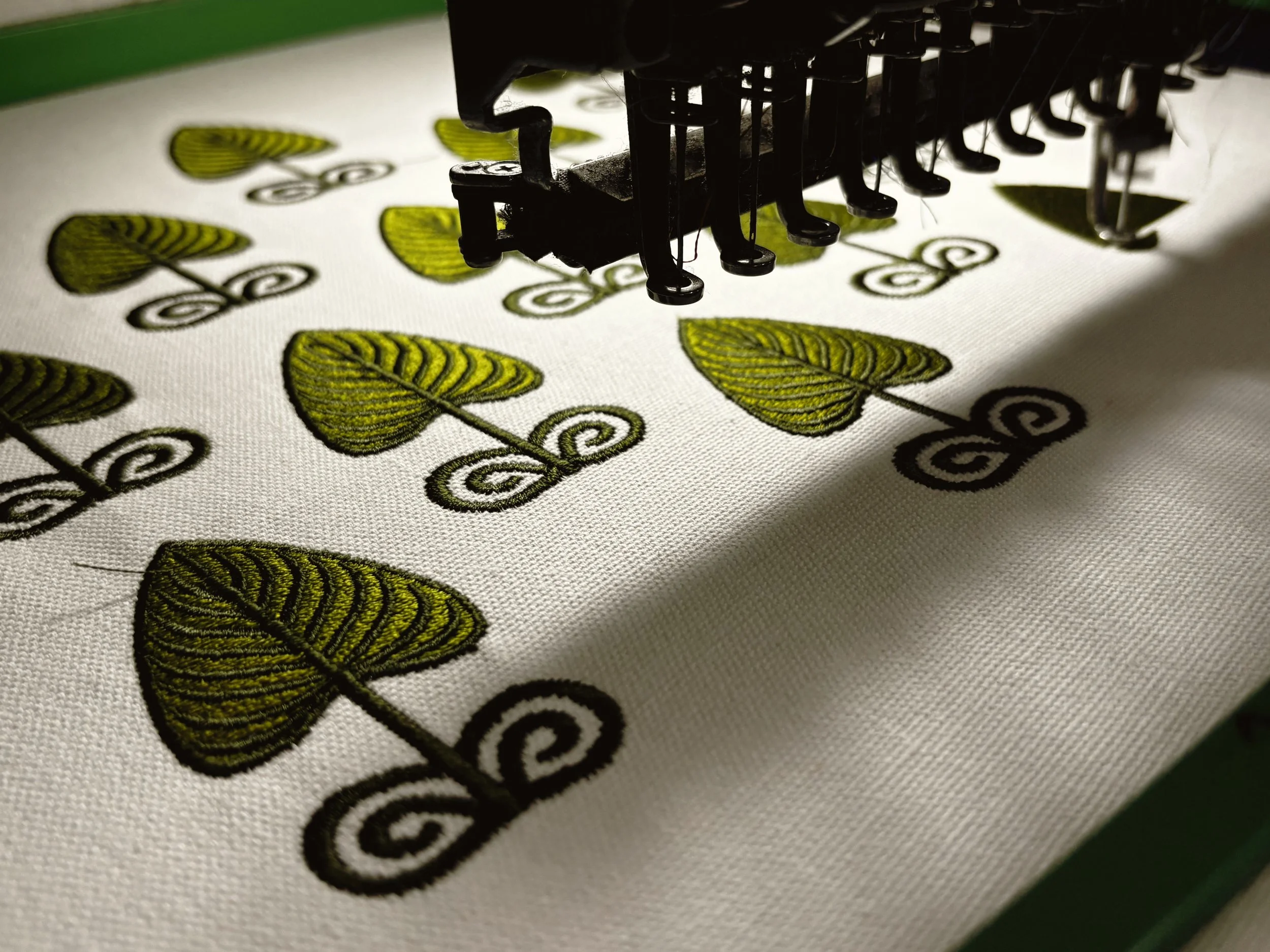
Baadiyah being digitally embroidered on 100% cotton
And then, with washing and time, something else happens. The cotton softens. The embroidery settles into it. The object begins to feel as though it has always existed, as though it arrived already worn in, already loved. This is not a quality you can design. It is a quality the material brings entirely on its own.
I have thought a great deal about why natural things have this effect, why a cotton tote carried daily becomes more pleasing to the hand over months, why a linen cushion left in the sun carries something that a synthetic one simply cannot, why we reach for these materials again and again even when others might be more convenient or more durable. I think it is because natural materials carry a kind of honesty. They do not pretend to be other than what they are. They show their age without apology. They hold the marks of use, the slight wear at a corner, the gentle fade of a colour, not as damage but as evidence. Evidence that the object has been present in a life.
A fabric that carries the earth in its weave asks nothing of you. It simply settles, softens, and belongs.
This is why everything we make at Bombay Design Co. is on natural cotton. Not as a technical specification or a sustainability statement, though both matter, but because the material is as much a part of the story as the design it carries. The pomegranate motif of Jardin Nar, the tree forms of Baadiyah, the geometric medallions of Bombay Deco, these designs were conceived for cotton, not in spite of its quietness but because of it. A design that must compete with its ground fabric for attention is a design that has already lost something. On natural cotton, the design can simply be what it is.
Honest. Settled. Present.
— Alpesh, Founder, Bombay Design Co. I'd love to hear from you, write to me at alpesh@bombaydesign.co