
How to Style Your Home with Art Deco
The simplest way to style your home with Art Deco is to resist the urge to commit to it entirely. Art Deco works best in a modern home as an accent language, a few pieces with strong geometry, warm metallics, and confident curves, set against calm, restrained surroundings. One well-chosen object does more than a themed room ever could.
I say this as someone who grew up surrounded by more Art Deco than almost anyone realises exists. Mumbai holds one of the largest collections of Art Deco buildings in the world, second only to Miami, and its Marine Drive and Oval Maidan ensembles are recognised by UNESCO. Those buildings taught me something that applies just as well to a living room as to a seafront: Art Deco is not about excess. It is about rhythm, repetition, and a kind of disciplined playfulness. Here is how to bring that home.
Start with one statement piece, not a theme
Art Deco announces itself. A sunburst mirror, a scalloped lamp, a fan-arch print, each of these carries enough visual confidence to anchor a corner on its own. Styling goes wrong when several statement pieces compete in the same sightline; the geometry that should feel rhythmic starts to feel noisy.
Choose one hero per room. Let everything around it stay quiet, plain walls, simple linen, solid-coloured furniture, so the piece has room to speak.
Lean on the three signatures of Deco
If you are unsure whether something will read as Art Deco in your space, check it against the style's three most recognisable signatures:
Geometry in repetition. Fans, arches, chevrons, and stepped forms, repeated in ordered patterns. This is the heart of the style, and it is why a single patterned object, a cushion, a coaster, a framed print, can carry the whole idea.
Warm metallics. Brass, gold, and bronze rather than chrome or silver. Deco metals should feel sunlit, not surgical. A gold-toned tray or coaster on a dark wood table is one of the easiest, lowest-commitment ways in.
Bold curves against straight lines. Deco loves the conversation between a sweeping arc and a hard edge, a rounded mirror on a panelled wall, a curved motif inside a square frame.
Pair Deco with softness, not more Deco
The most liveable Deco-styled rooms balance the style's precision with something tactile and imperfect: natural cotton, linen, hand embroidery, aged wood. The geometry provides structure; the texture provides warmth. This pairing is not a compromise, it is historically honest. In Mumbai, Art Deco apartments were always lived in alongside handwoven textiles and carved furniture. The style has never needed to stand alone.
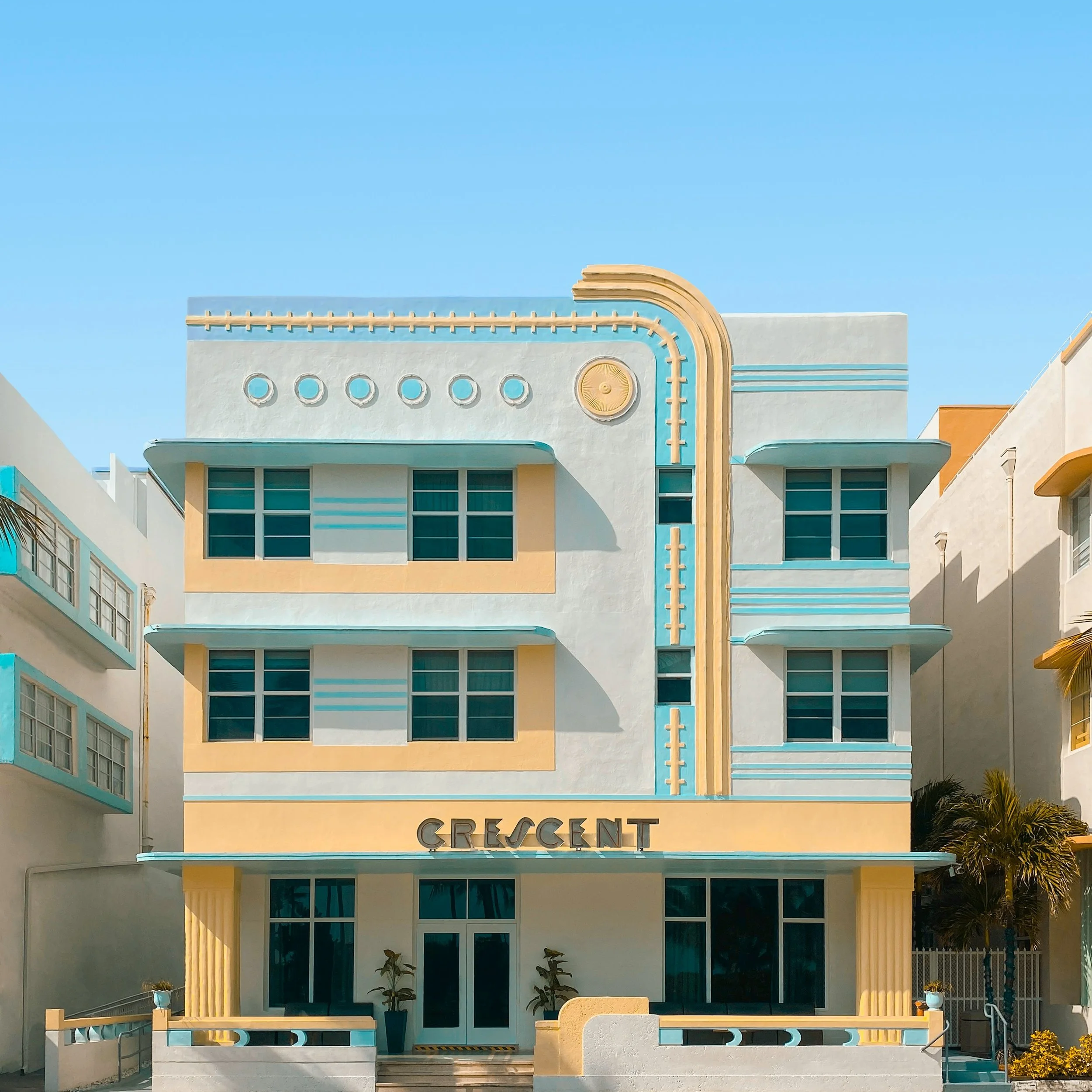
An Art Deco Building at South Beach, Miami Beach. Photo by Clark Van Der Beken on Unsplash
Use colour the way Deco buildings do
Mumbai's Deco facades taught me that the style's colour story is quieter than the Gatsby cliché suggests: sea-greens, sand tones, deep teals, and warm terracottas, with metallic accents doing the glamour work. In a home, that translates to a deep, grounding base colour, a navy, a dark teal, a forest green, with one warm accent moving through the room. Gold does not need to shout when the background knows how to hold still.
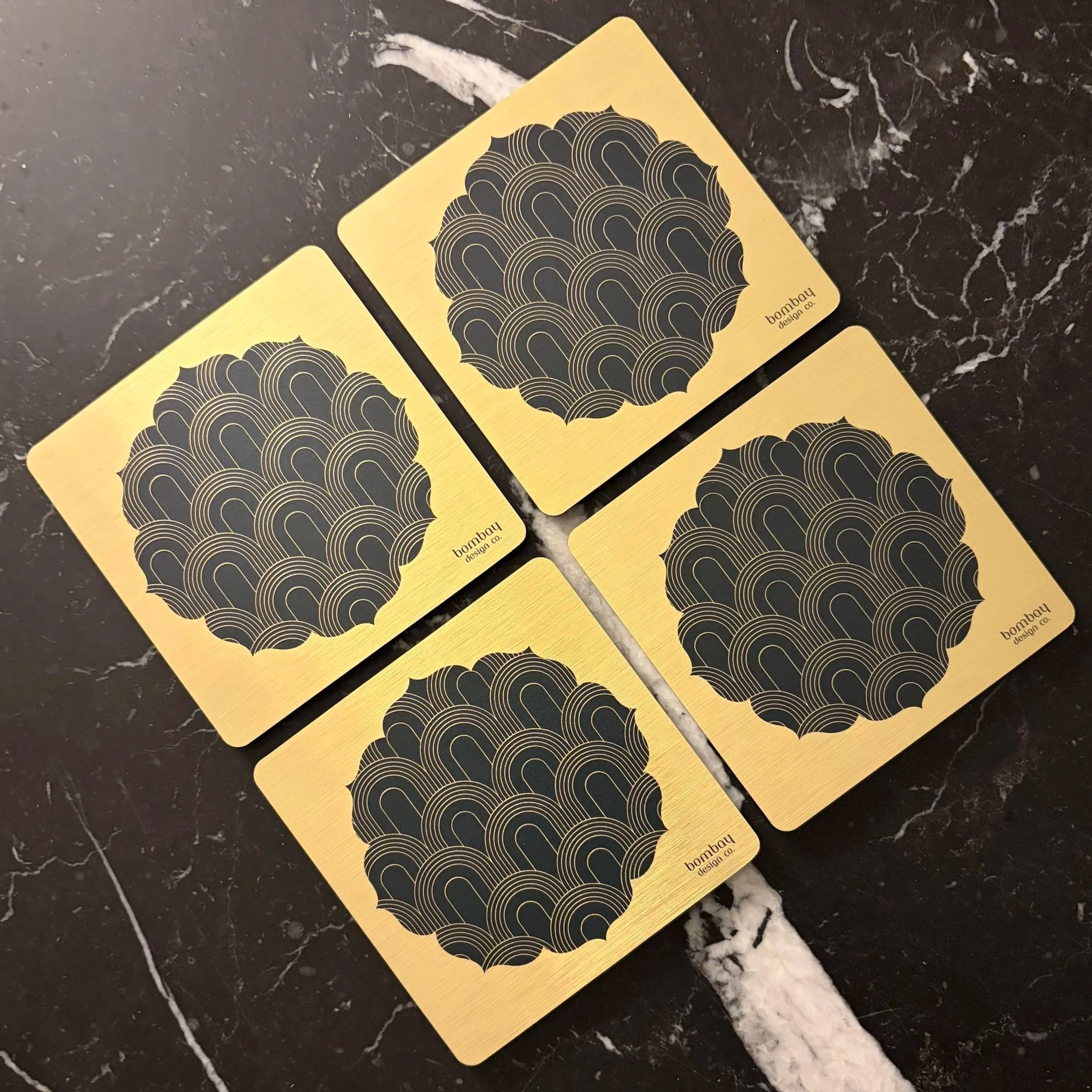
A set of four Bombay Deco Coasters from Bombay Design Co.
Small objects are the honest way in
Not everyone can, or should, buy a Deco armchair. The style's genius is that it survives miniaturisation beautifully, because it was always about pattern and proportion rather than scale. A coaster, a tote, a cushion, a tray: these carry the full grammar of Deco at a fraction of the commitment, and they let you test whether the style belongs in your home before you go further.
This is the thinking behind our own Bombay Deco collection, a quiet dialogue between the playful geometry of Mumbai's Art Deco and the soft, sweeping arches of Rajput and Mughal architecture. The coaster prints that layered arch pattern on brushed gold aluminium, so the metallic warmth Deco loves sits right under your glass, and the Studio Tote carries the same motif in Midnight Cyan and Terra Cotta, printed with water-based ink on natural cotton in the UK. Both are designed to do exactly what this guide describes: bring the rhythm of Deco into a room, or a day, without redecorating your life around it.
Three quick pairings to try
The reading corner. A dark leather or velvet chair, one brass floor lamp, a Deco-patterned coaster on the side table. Nothing else patterned within arm's reach.
The console moment. A plain wood console, one arched or sunburst mirror above it, a single geometric object below, a tray, a small stack of books, a coaster catching the light.
The everyday carry. Deco does not have to stay indoors. A patterned tote against plain, tonal clothing is the same principle as a statement piece against a quiet wall.
Art Deco was never meant to be a museum piece. It was designed for daily life, for lobbies and doorways and the corner of an ordinary afternoon. Style it that way, one confident object among quiet ones, and it does what it has always done best: turn an everyday moment into a small moment of art.
— Alpesh, Founder, Bombay Design Co. I'd love to hear from you, write to me at alpesh@bombaydesign.co